I am back at 10 O’Clock Live. When it isn’t live, you can again watch clips, like this one people like [NB: the final "...unless you count all those times they had a go at witches" is unforgivably omitted and archivists should note that what sounds like "Tory boys" is in fact "toy boys"]:
It’s also irrepressibly public-spirited, people shaking hands on the street are, apparently, ‘saying I love you’ – illustrated in the Attenborough video, oddly, by two hippopotamuses fighting each other in the Okavango river.
And this is not the first time What A Wonderful World’s generosity of spirit has been juxtaposed with less-than-cheerful imagery.
“But whoever initially misidentified the music must have a tin ear. Bohemian Like You sounds like a Rolling Stones megamix with an emphasis on One Hit (To The Body) off Dirty Work, while Rocks sounds like a Stones megamix with an emphasis on Little T&A off Tattoo You.”
I am also compiling a Big List of all music played at all party conferences, politicians’ Desert Island Discs, etc. This will help.
I have happy memories of every spear and tip I ate between St George’s Day and Midsummer’s Night, but as the ancient folk maxim has it: “Never eat asparagus while watching Strictly Come Dancing.” And contemplating eating asparagus in September, it struck me: the elation I feel when the vegetable appears is bound up with the way it heralds summer. Pondering the changing of the seasons at this time of year is likely to throw you into a panic over Christmas arrangements.
So I put Santa out of my mind and the spears onto a plate.
“Flick through a dictionary and you’ll notice something about the English language’s ‘tw’ words. We have a few related to ‘two’: twin, twelfth, twilight and so on. And there’s a tiny minority of what you might call fairly sensible words: tweezers, twig and of course tweed.
“The rest, though, tend to be of a type that’s more playful or, depending on taste, more grating. ‘Tw-’ words can be about inanity or ignorance: twit, twerp, twonk or twaddle. They can suggest lightness, smallness or delicacy: tweak, twiddle or twinkle. Or they can flag up that you’re being self-consciously old-fashioned: ’twas and ’twere; ‘twixt and ‘tween. All very twee.”
“Others suggest [that] those of us hooked on crosswords might want to justify the time passed by pointing to the large vocabulary we’ve amassed – or, perhaps, to our pleonasm, to our Brobdingnagian prolixity. Well, boo-poo to that. (I admit I enjoyed learning the word ‘pleach’ from last Tuesday’s Times, but it may be many years until I get to use it in a sentence near a hedge.)”
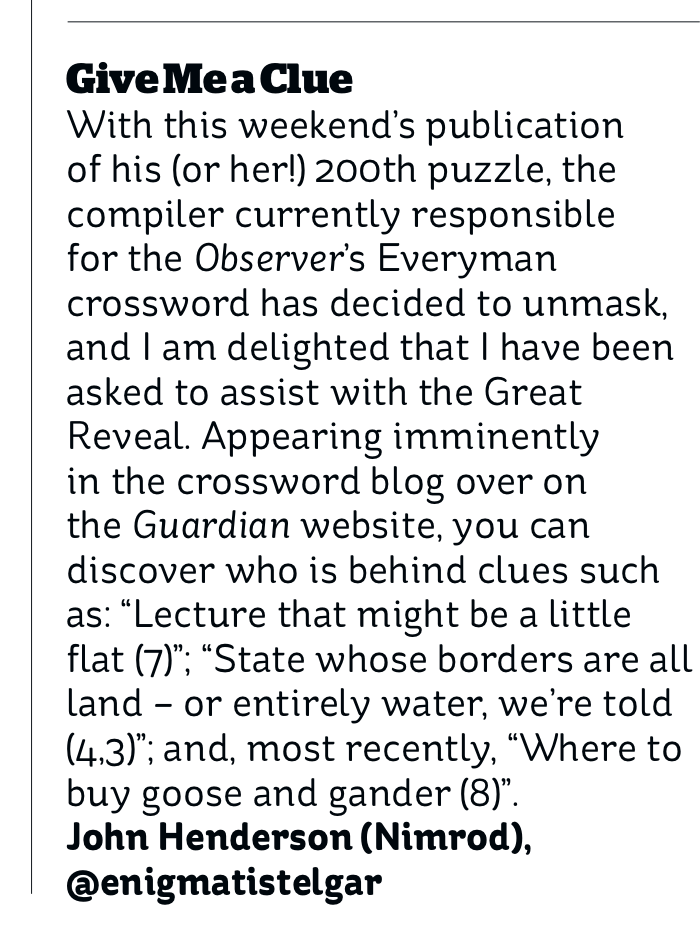
It’ll be a mixture of the week’s best and funniest clues, tips for n00bs and features on awesome stuff like when crosswords feature in programmes like Rubicon and The Hour.
Photo is of Guardian 25,402 by Puck. The only answer I’ve put in is wrong. “Aday in dopey stupor, endlesslylike t-h-i-s? (6,3)” should give SPACEDOUT, not SPREAD OUT as I thought. This bodes ill.
“The Clash were supporters of pirate radio and considered launching their own station; this love song to the wireless signal recounts what, in punk terms, is up-to-the-minute and truthful news. But it isn’t saying ‘come and enjoy the canoe slalom’.”
Major hoorays to Marcus Gray’s Route 19 Revisited for the key fact that London Calling was originally inspired by Joe Strummer’s dislike of sports fans visiting London, as he explained to Kosmo Vinyl (Clash On Broadway box set booklet, 1991). Awkward [Update [1 Aug]: Praise be! Route 19 is imminently in paperback. There is nothing more interesting to say about 1979; I know – I tried! Buy it – it is The One.]
Sadly there was no space to mention Clash fan of Indian origin Harraj Mann, questioned in 2006 under the Terrorism Act after a taxi driver taking him to Heathrow airport became alarmed that he was listening to London Calling and called the police. The incident was seen as a massive overreaction, suggesting either that the song has lost its incendiary power, or that the authorities were being over-cautious – or both.
Also neglected was the way Strummer starts “doing” Tommy Steele’s Singing The Blues at the end (“I’ve never felt so much a-like…”), never better described than by Tom Ewing: “No consonant is safe with Steele around, words pool into one another in a shrugged gush of pre-meditated moodiness.”
Update [30 Jul]: Here is wireless nabob Scott Simon of NPR’s Weekend Edition Saturday yakking with me (see also NPR’s blog The Record):
Here’s an old BBC “London Calling” poster: “Throughout Europe, men and women are risking imprisonment, and even death, to hear the news from London, because they know it tells them the truth.”
If Anders Breivik has just printed off the internet, maybe we shouldn’t make too much of his manifesto just yet.
Among the blogs I read every day is My Right-Wing Dad, where appalled young American Democrats share emails they’ve received from relatives who have done the “FORWARD TO EVERYONE YOU KNOW!!!” thing. Among the icky racist cartoons and the odd genuinely funny bulletin-board-style gag are volumes of interminable implausible “research” about Bad People.
It’s the type of content that’s sometimes neither visible on the normal old web, nor hidden in the darknet: the stuff that pings in and out of inboxes, across forums and onto Yahoo! Groups. And if you’ve read that stuff too, Anders Behring Breivik’s “manifesto” must seem drearily familiar.
Why, you might otherwise wonder, would a Norwegian who claims an affinity with England write with the rhythms and cadences of amateur American net culture? And why is he so interested in the 1980s curriculum at Stanford University? The answer may be that Breivik didn’t so much “write” much of what he calls his “book” as copy, paste and twiddle. If you’re fascinated by plagiarism – I know I am – the twiddling will be familiar too – find/replacing terms throughout, the odd rejigging of sentences at the top of paragraphs to leave an apparently new document, still leaving inconsistency in tone, spelling and style.
Hulking chunks of the document come with attributions, and the latte wing of the UK twitterverse is currently sharing mentions of Jeremy Clarkson, Melanie Phillips and other apparent provocateurs; simultaneously scary and pathetic is the amount that should be attributed, but isn’t.
Here’s an extract from Chapter 1, What is “Political Correctness”? by William S. Lind, apparently a military pundit and sometime senatorial aide:
And here’s Breivik, changing the location to Europe:
From Chapter 2, The Historical Roots of “Political Correctness” by Raymond V. Raehn, apparently a strategist:
And Breivik:
Finally for now, here’s the end of Chapter 3, Political Correctness in Higher Education by T. Kenneth Cribb, Jr, apparently a Reagan aide:
And, again, with a transatlantic transplant:
If this really took Brievik nine years, someone should have told him about CRTL+C; CRTL+V. You don’t need to type it all back in again. “Nine years” is a great line to get attention, but not one to be repeated without a bit of scepticism.
There’s plenty more, of course: Unabomber borrowings; reading lists cribbed from university courses, inevitable Wikipedia scrapes, and a critique of mass media seemingly lifted from an old leftish site after the removal of an approving reference to a John Pilger programme about Palestine. If you’ve ever said to yourself, “what a world we live in!”, you’ll probably shudder as you find something you agree with: even the bonkers end of the net is right at least twice a day.
It looks at the moment as if Breivik is positioning his murders as a kind of “marketing” for these pages of bilge, hoping they’ll be translated and read across the globe. So here’s the thing.
We should bear in mind that Brievik hasn’t, as some reports have it, proved himself “articulate”, or “well-read”, or some kind of intellectual mastermind. There’s little in his manifesto that couldn’t be produced after an all-nighter on the net hopped up on meds. There are, let’s say, plenty of self-published first-time authors whose work deserves more serious attention.
The manifesto might contain technical clues of use to the police; it might contain political or philosophical clues as to why he did what he did. I’d be fascinated if it did, but I don’t know, and neither do you.
Perhaps Boris Johnson is right, and this is a story about “a narcissist and egomaniac who could not cope with being snubbed” by a girl “in favour of a man of Pakistani origin”; perhaps anti-conservative commentators are right that the amount of hate-text and fear-screeds already published are necessary or sufficient for acts of terrorism. It’s – obv – far too early to say.
But it’s not too early to say that Breivik is trying to build up his pontification in court today in the hope that international media will handle it like an evil genius’s plot-changing scene in a thriller rather than a mish-mash of other people’s wibble. That would seem to be missing the point and playing a loser’s game.
Video from Newswipe about media treatment of mass killers – as relevant and must-watch now as it was then.
Above is an image of “Jonnie Marbles” getting handcuffed outside the Wilson Room in Parliament. Below are images of the rest of us in the room being ejected. Here’s why everyone there found the stunt infuriating:
The queues had started over seven hours before the committee began. It was like the Royal Wedding, but – genuinely – with normal people. Oldies, supermarket employees, families – normal. And while it was a festive mood, it was also tense: the official line as to how many people would get into the room kept changing, and some people were certainly facing a wasted day. Questions popped about. Was space being cleared for the Dowler family? Had the tiny Wilson Room been chosen so as not to look like a show trial? Was Jemima Khan trying to hop in? At one point, we were told that the Doorkeepers were considering letting us sit on each other’s laps if we so fancied. Westminster reporters were heckling sketchwriters about their slim chance of making it in. So when we later found out that the front of the queue had been a gang with a bag full of shaving foam, “comedy” wasn’t the first word that sprang to mind. Nor was “activism”. “Shabby oaf” and “stupid tit” were some of the descriptions I did hear.
The dynamic in the room was entrancing – until it was cut off. Murdoch Jnr’s longer spiels were worthy of your favourite guest on Just A Minute – circumscribed vocabulary expressed with eerie diction, fending off attempts at interruption. “I’m happy to answer that,” indeed. As for Murdoch Snr, each time he rhythmically rapped his fin on the desk, the Wilson Room started by going instantly silent and then seemed to get more so. It wasn’t possible to tell whether this was deference on the part of the MPs, or anticipation of a juicy detail – but it was spell-binding. Knowing that the Murdochs, as non-subjects, were not compelled to attend meant that the ultimate authority never seemed to settle, though Headmaster Whittingdale had the lion’s share. Some of the questions felt a little random, but might have been leading somewhere that’ll become apparent in the months to come; we simply couldn’t tell. The experience was like those Richard Norton-Taylor inquest-recreation-play things, except real. Except – again – sometimes it didn’t seem real. There was Rupert Murdoch! In a room! Boom! Gone! For one afternoon, a functional room filled largely with shirted men was the greatest show on Earth. I swear I never once heard anyone whisper “You know what they should send in? Some clowns.”
Which brings us to another shared source of exasperation. Moguls don’t tend to hang out in public space. This was like seeing Thor in a Job Centre. You don’t have to be fanciful or grandiose to feel proud that This Is How We (Eventually) Do Things – after all the tales of deceit and connivance, here was an open, public event, open to the public, where the public would show it was decent and fair. The public wasn’t supposed to be baffling, threatening or in any sense dickish. People were surprised that they were allowed to nip to the loo, drink fizzy water and chew gum. Hey – The Authorities don’t think we need to be treated like infants! Hmm.
Then, at just after ten to five, it was all over. An amazing, inspiring event ceased to exist as a piece of public property. I’d even missed the affray itself, because I was incredibly preoccupied with another bag-holder behind me, who had also stood up and seemed to be working his way round from the other side. Next we shuffled around as per the coppers’ yelled instructions, before eventually and sullenly trudging down the corridor to join Jemima Khan in the Boothroyd Room, cursing Jonnie Marbles. The committee was on the screens there, but what’s the point of watching something on TV if you have to remain decently dressed and you can’t even nip off to get a sandwich during another of Murdoch Jnr’s sixty-second dashes?
Finally, the speculation started again, including the inventive theory that News Corp had put the jackass up to it. “Because,” a punter noted, “that was the best thing to happen to Rupert Murdoch all day.”
“Freddie Mercury used a piano as the headboard of his bed. The double-jointed Mercury would awake with inspiration, reach up and back behind his head and play what he’d heard in his dreams. This was how Bohemian Rhapsody began.”
“[P]eople ask coyly about the, um, after-smell. I’ll spare excess detail [but] I welcome it as a reminder of a glorious meal. Everyone’s smells, incidentally, but not everyone can smell it. It’s better to avoid picturing the medical research that led to that finding.”
The experiment is enough to give Comment Is Free users a good name.
If you too love either asparagus or repetition, you can watch the slideshow of the 2011 season above.
Inspired by my own article about Google-proofing the pub quiz, I am resurrecting Just The Gist.
This was – and now is again – a music quiz where you guess the song title based on a precis of its narrative content. This is a “soft launch”. Later, there might be themes and prizes and that.
“Text-messaging Is Destroying the Pub Quiz As We Know It, noted the Super Furry Animals in 2001. Little did they know that the pub quiz of 2011 would start with the host insisting: ‘OK, iPhones away, please. Yes, very clever – and Androids. All phones away.’
“Cheating has always been possible in pub quizzes. But while once the dishonest quizzer had to pop out to phone a friend, or wait for a text message reply, phones with fast internet access have taken cheating possibilities to a new level.”
“I was able to avoid this punitive pricing, having heard that a pick-your-own 20 minutes from my home was planning a one-off ‘early Sunday’. Thrilling, certainly, and less than half the price of the supermarkets, but also tense. Word was sure to have spread – would the early crop be abundant enough? There were already nine other cars queueing 20 minutes before opening and the mood was edgier than a crack den in a power cut.
“Once the gate had opened and we were picking, one pensioner made the mistake of switching rows halfway. If it had been one of those farms that offers pickers miniature serrated scythes, he’d have perished among the remaining stumps.”